
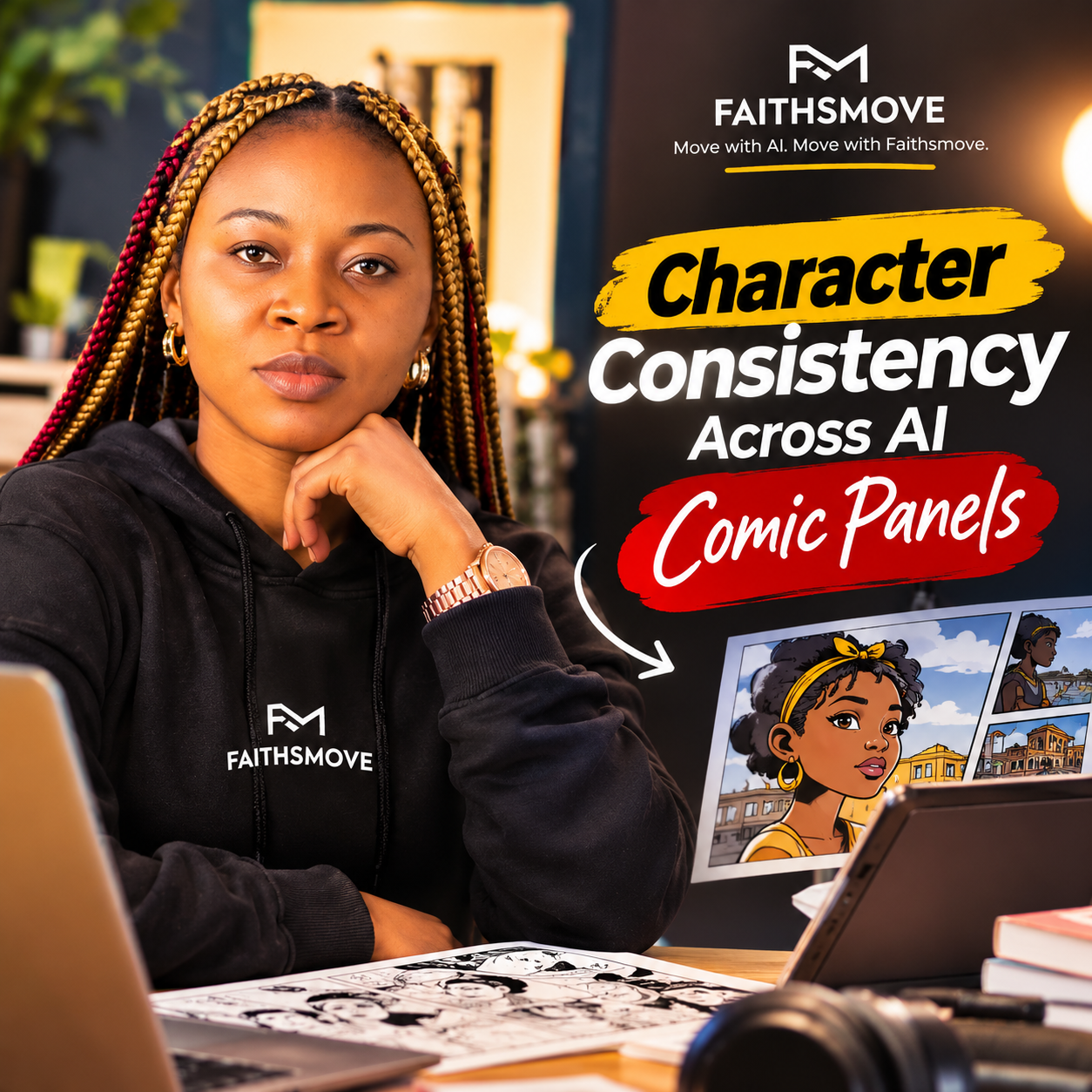
Comic & Storybook Creation · Case Study
Character Consistency Across AI Comic Panels: The Area 419 Method
How the cast of Area 419 of Life stays recognisable across dozens of panels — identity blocks, wardrobe canon, panel batching and the repairs that happen in post.
Readers forgive a lot in a comic. They will forgive a simplified background, a flat colour, even an odd hand. What they will not forgive is a character whose face changes between panel three and panel four — the moment that happens, they stop reading the story and start auditing the artwork. Everything below comes out of producing Area 419 of Life, an episodic comic where the same cast has to survive dozens of panels per episode.
Start with a written character bible, not images
Before generating anything I write each character in plain language, and I keep the wording fixed forever. A usable identity block is specific in the places a model tends to drift and silent everywhere else:
- Age and build — "34, broad-shouldered, medium height".
- Face anchors — two or three unmissable features: a gap tooth, a scar above the left brow, round wire glasses.
- Hair — style, length and how it behaves, not just colour.
- Wardrobe canon — one default outfit described down to the colour of the buttons.
- Skin tone and lighting — described in words you will reuse in every prompt.
Vague adjectives are the enemy. "Handsome" produces a different man every time; "gap tooth, close-cropped hair, square jaw, small mole on right cheek" produces the same man repeatedly.
Turn the block into a reference sheet
With the block written, I generate a reference sheet: front, three-quarter and profile views on a neutral background, plus one full-body shot showing the default outfit. I regenerate until all four agree with each other, then freeze them. From that point the sheet is the source of truth — when a panel disagrees with the sheet, the panel is wrong.
Batch panels by character, not by page
The single biggest consistency win is scheduling. Instead of generating page one then page two, I generate every panel featuring one character in a single sitting, in the same session, with the same reference and the same seed family. Drift accumulates over time and across sessions; batching keeps it inside a narrow band. Only when a character's panels are done do I move to the next.
Say the same thing every time
Each panel prompt is assembled from fixed parts in a fixed order: identity block, wardrobe, expression, action, camera framing, background, style block. Only the expression, action, framing and background change between panels. Writing the same words in the same order is boring and it works. When I need a costume change for a story reason, I write a second wardrobe block and treat it as canon from that scene onward.
Frame for readability
Comics are read fast. I vary framing deliberately — establishing wide, mid for dialogue, close for emotion — and I keep faces large enough to carry expression on a phone screen. A panel that requires pinch-zoom has failed regardless of how detailed it is. Where a model struggles with a pose, I change the camera rather than fight the pose: a hand-heavy gesture becomes an over-the-shoulder shot.
Repair in post, always
Perhaps a third of finished panels get touched up outside the generator. Common repairs: nudging eye position, evening skin tone across a page, patching a background, removing a stray sixth finger, and unifying colour with a single grade across the whole episode so pages read as one artefact. Text is never generated — every speech balloon, caption and sound effect is set by hand in the layout tool, which keeps typography clean and lettering editable when a line needs rewriting.
Page rhythm beats panel perfection
Once panels exist, the episode lives or dies on layout. I keep panels per page low, give the beat that matters the most space, and end each page on a question so the reader turns it. A merely good panel in the right position outperforms an outstanding panel buried mid-page.
The checklist I run before publishing an episode
- Every character matches their reference sheet, page by page.
- Wardrobe is continuous unless the story changed it.
- Lighting direction is consistent within each scene.
- Balloons are readable at phone width and never cover a face.
- The last panel earns the next episode.
Consistency is not a model feature you unlock; it is a production habit. Write the bible, freeze the sheet, batch the panels, repeat the same words, and repair the rest by hand — that is the whole method, and it is why the residents of Area 419 still look like themselves twenty pages later.